What happens after the handoff is the risk you can't see.
A seed is a real, working contact — email address and phone number — planted into your partner feeds and CRMs. Whether you're coaching a rep's follow-up or proving a partner didn't misuse your data, each seed captures what actually happened — timestamped, evidenced, ready to act on.
Two ways to monitor partner and affiliate behavior
Coach a partner's call cadence
Send a seed through a new partner or rep like a real lead, then compare what actually happened against the cadence you expect — first touch time, number of attempts, days to close contact. The cheapest way to see if a partner is actually working a lead the way they said they would.
See it in action →Prove a partner didn't misuse your data
Seed your partner feeds and CRM exports, and get an immutable, timestamped record of every call, text, and email a seed receives — evidence built to hold up with a regulator, a board, or the partner themselves.
Book a compliance call →Already distributing leads through a partner network? The $1/$9 seed tiers cover routine partner vetting — order seeds, plant them, and watch for resale.
Your monitoring stack sees intent. It stops at the click.
Page scans, ad trackers, and QA reviews show you what a partner says they'll do. Assumed shows you what happens after — the part your current tools can't reach.
Without Assumed
- Page scans catch misalignment, not misconduct
- QA checks disclosures, not lead resale
- Partner behavior after handoff is a blind spot
- “We assume it’s fine” is the compliance answer
With Assumed
- Seeded contacts move through the feed like real leads
- Every call, text, and email to a seed is timestamped
- Unapproved contact is flagged the moment it happens
- Evidence exports straight into an audit or termination case
Three steps, no integration required
Deploy seeds
Order contacts and plant them into the list, CRM, or partner feed you want to test.
Reveal behavior
Seeds receive calls, texts, and emails exactly like a real consumer would — every contact logged automatically.
Review evidence
A chronological trail, labeled and timestamped, that holds up in an audit or a partner conversation.
Both motions run on the same evidence
A target cadence, compared to what actually happened
Set the cadence you expect a partner to hit — first email within an hour, five touches in five days — against a seed's timestamped activity, and see the delta without exporting a spreadsheet.
An evidence trail built for a regulator, not a spreadsheet
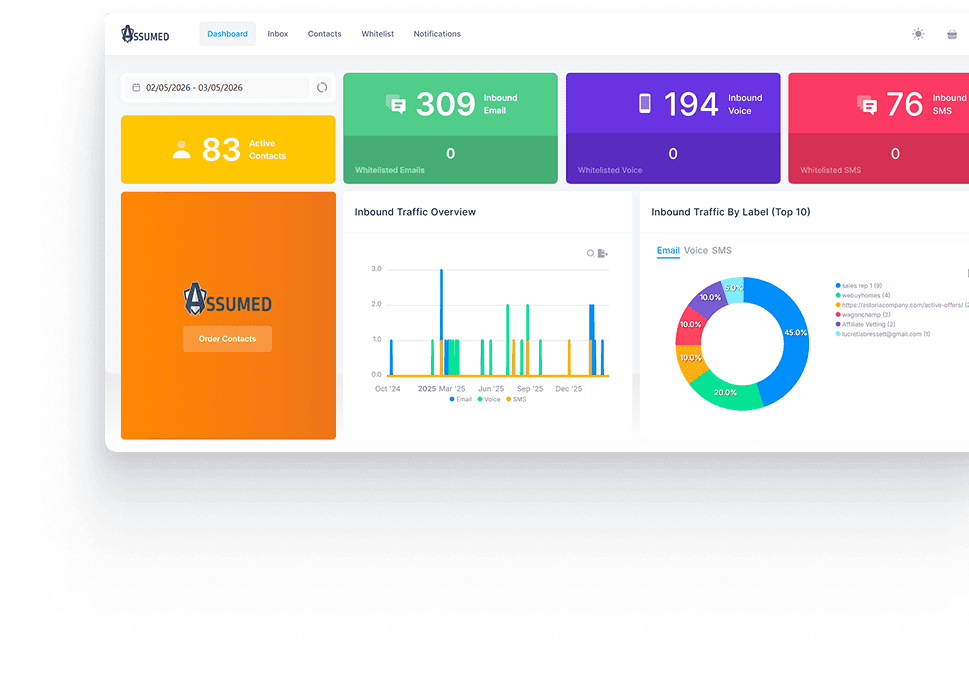
Active contacts, inbound email, voice, and SMS — broken out by channel the moment they arrive, with the same timestamped record behind every stat.
Notes from the downstream
Visit the blog →The Ultimate Supplier Due Diligence Checklist for SaaS Companies
For a SaaS company, your platform is only as strong as your weakest vendor. Here is the ultimate framework to standardize onboarding, uncover hidden risks, and continuously monitor your SaaS supply chain.
Canary Tokens and Active Defense: A Modern Approach to Data Leak Prevention
Security engineering is shifting toward active defense — deploying canary tokens and seeded data to turn your sensitive data into its own alarm system.
The Top 8 Insider Threat Indicators: How to Spot and Stop Internal Data Leaks Early
Most enterprise security budgets skew heavily toward defending the perimeter, but sometimes the threat comes from inside the house. Identifying insider threat indicators early is the difference between an intercepted policy violation and a headline-making data breach.
Beyond Assumptions: Why Assumed is Proud to be a Cybersecurity Awareness Month Champion
October is Cybersecurity Awareness Month, and at Assumed, we are thrilled to step up as an official 2026 Cybersecurity Awareness Month Champion.
How to Build an Open Enrollment Vetting Process for Lead Buyers & Sellers
Open enrollment is the highest-stakes window in insurance lead generation. An open enrollment vetting process helps both buyers and sellers protect margins, compliance standing and brand reputation during the busiest quarter of the year.
Build a Better Vetting Process for Q4
Fourth-quarter sprints bring intense pressure: remaining budgets must be deployed efficiently, revenue targets must be reached, and ambitious holiday campaigns must launch flawlessly. Without a highly structured vetting process, operational chaos takes over.
Build a Secure Know Your Customer (KYC) Process, Step By Step
Traditional Know Your Customer checks focus almost entirely on static, point-in-time onboarding audits. A modern compliance pipeline requires moving past passive trust toward active, continuous oversight.
Using Affiliate Fraud Prevention Tools in Addition to Traditional Ad-Trackers
Traditional ad-trackers were built to measure conversion performance, not to watch for partner misconduct. Relying on basic click and server telemetry leaves modern brands dangerously exposed to compliance violations, brand damage and revenue loss.
What is KYC (Know Your Customer)? A Guide for Modern B2B Platforms
Know Your Customer (KYC) and Know Your Business (KYB) are processes for verifying the identity, legitimacy and risk profile of commercial partners before and throughout a business relationship.
Third Party Trust: How Advance Client Solutions Finds Peace of Mind in the Lead Gen Industry
Learn how Advanced Client Solutions uses Assumed to detect lead theft and build third party trust. Real success story in lead generation security.
How Are You Vetting a New Vendor? A Case Study on Health Insurance Forms
How are you vetting a new vendor? A case study on the importance of vendor vetting in healthcare.
The Ultimate Supplier Due Diligence Checklist for SaaS Companies
For a SaaS company, your platform is only as strong as your weakest vendor. Here is the ultimate framework to standardize onboarding, uncover hidden risks, and continuously monitor your SaaS supply chain.
Canary Tokens and Active Defense: A Modern Approach to Data Leak Prevention
Security engineering is shifting toward active defense — deploying canary tokens and seeded data to turn your sensitive data into its own alarm system.
The Top 8 Insider Threat Indicators: How to Spot and Stop Internal Data Leaks Early
Most enterprise security budgets skew heavily toward defending the perimeter, but sometimes the threat comes from inside the house. Identifying insider threat indicators early is the difference between an intercepted policy violation and a headline-making data breach.
Beyond Assumptions: Why Assumed is Proud to be a Cybersecurity Awareness Month Champion
October is Cybersecurity Awareness Month, and at Assumed, we are thrilled to step up as an official 2026 Cybersecurity Awareness Month Champion.
How to Build an Open Enrollment Vetting Process for Lead Buyers & Sellers
Open enrollment is the highest-stakes window in insurance lead generation. An open enrollment vetting process helps both buyers and sellers protect margins, compliance standing and brand reputation during the busiest quarter of the year.
Build a Better Vetting Process for Q4
Fourth-quarter sprints bring intense pressure: remaining budgets must be deployed efficiently, revenue targets must be reached, and ambitious holiday campaigns must launch flawlessly. Without a highly structured vetting process, operational chaos takes over.
Build a Secure Know Your Customer (KYC) Process, Step By Step
Traditional Know Your Customer checks focus almost entirely on static, point-in-time onboarding audits. A modern compliance pipeline requires moving past passive trust toward active, continuous oversight.
Using Affiliate Fraud Prevention Tools in Addition to Traditional Ad-Trackers
Traditional ad-trackers were built to measure conversion performance, not to watch for partner misconduct. Relying on basic click and server telemetry leaves modern brands dangerously exposed to compliance violations, brand damage and revenue loss.
What is KYC (Know Your Customer)? A Guide for Modern B2B Platforms
Know Your Customer (KYC) and Know Your Business (KYB) are processes for verifying the identity, legitimacy and risk profile of commercial partners before and throughout a business relationship.
Third Party Trust: How Advance Client Solutions Finds Peace of Mind in the Lead Gen Industry
Learn how Advanced Client Solutions uses Assumed to detect lead theft and build third party trust. Real success story in lead generation security.
How Are You Vetting a New Vendor? A Case Study on Health Insurance Forms
How are you vetting a new vendor? A case study on the importance of vendor vetting in healthcare.
“If a client believes another client is double-selling their leads, that issue takes precedence over everything else.”— iRelo, auto transport & moving lead generation
Efficient partner vetting
Replaced manual spot-checks with a faster, reliable system for flagging partners who don't meet lead-handling standards.
Centralized visibility
One place to see every seed and every downstream contact — the lead's journey stays transparent.
Unauthorized contact detection
Resale and misuse surface immediately instead of through a client complaint.
Vet how reps actually follow up
Compare a rep or partner's real response time and touch count against the cadence you set — the near-term, lowest-friction way to start.
Prove partners aren't misusing data
Audit-ready evidence for regulators, boards, and the next TCPA inquiry — the highest-value motion, run as a managed engagement.
Vet your own partner network
Order seeds through the self-serve tiers, plant them in your partner feed, and watch for resale or double-quoting — same evidence trail, no extra setup.