
Table of Contents
Most enterprise security budgets skew heavily toward defending the perimeter, but sometimes the threat comes from inside the house. Whether malicious, compromised, or simply negligent, insiders have what external threat actors spend months trying to steal: legitimate, authenticated access. Identifying insider threat indicators early is the difference between an intercepted policy violation and a headline-making data breach.
For CISOs, IT Security Directors and SOC Managers, the challenge lies in separating malicious intent from normal daily operations. Standard monitoring tools often generate an overwhelming volume of false positives, masking the subtle signs of data exfiltration. To protect sensitive assets, security leaders must move beyond passive logging and learn to spot the nuanced technical, behavioral and financial anomalies that signal an impending threat.
The cost of ignoring internal red flags is steep. According to the 2026 Ponemon Institute Cost of Insider Risks Report, the average annual cost of insider threats has surged to $19.5 million per organization. Worse, security teams take an average of 67 days to contain an insider incident, giving malicious actors and compromised accounts more than two months to quietly exfiltrate your most sensitive data.
What are the top insider threat indicators? Insider threat indicators are anomalous digital, behavioral or financial activities that suggest an employee, vendor or contractor may be misusing legitimate access to compromise organizational data. Top indicators include massive, unauthorized data transfers at odd hours, sudden spikes in restricted file access (especially after a resignation notice), routine bypasses of security protocols and any interaction with deceptive internal assets like canary tokens.
Digital & Technical Red Flags of Insider Threat Indicators
The strongest evidence of an insider threat lives in your network logs and access controls. However, sophisticated insiders know how to operate in the gray areas of their legitimate permissions. Effective insider threat detection requires establishing a rigid baseline of normal activity so that deviations stand out immediately when using these insider threat indicators.
1. Unusual Data Transfers and Spikes in Export Volume
An employee downloading massive volumes of sensitive files like source code, customer databases or proprietary schematics is a primary indicator of data hoarding. Pay close attention to:
- Sudden reliance on unauthorized cloud storage platforms (e.g., personal Dropbox or Google Drive accounts).
- Frequent use of USB drives or external physical media on endpoints where such activity is rare.
- Spikes in print volume, which is a low-tech but highly effective method of preventing data leaks from triggering digital alarms.
2. Off-Hours Network Access
While remote work has blurred the traditional 9-to-5, baseline behavior still exists. If an employee who typically logs off at 6:00 PM suddenly begins establishing VPN connections and querying sensitive databases at 3:00 AM on a Sunday, it is an anomaly. Malicious insiders often use off-hours access to evade real-time SOC monitoring.
3. Unauthorized Privilege Escalation and Snooping
Users should only access the data required to perform their specific roles (Principle of Least Privilege). Technical red flags include:
- Users repeatedly attempting to access directories, shared drives or systems outside their departmental scope.
- Employees exploiting system misconfigurations to escalate their administrative privileges.
- “Snooping” behavior, where an insider browses through executive communications, HR files or unencrypted password vaults without a valid business justification.
Behavioral & Workplace Indicators
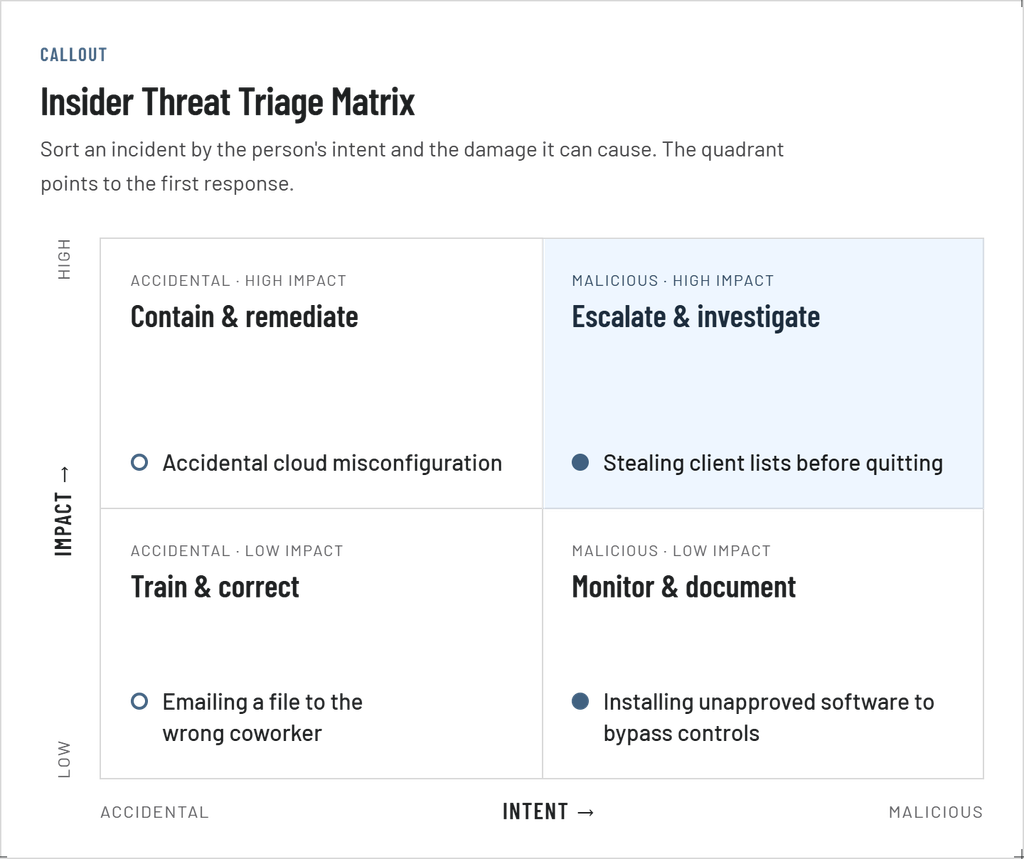
Not all insider threat indicators begin at the keyboard. Often, the earliest behavioral red flags appear in HR contexts before they trigger an IT security alert. Cross-departmental communication between HR, legal and the SOC is important for spotting these indicators.
4. Disgruntled Behavior and Sudden Dissatisfaction
A historically steady employee who suddenly becomes vocal about grievances, expresses deep dissatisfaction with management or was recently passed over for a promotion has a heightened risk profile. While most disgruntled employees do not become data thieves, a significant percentage of malicious insider breaches stem from a desire for corporate revenge or a feeling of being undervalued.
5. Resignation Notices Combined with File Hoarding
The 30-day window before and after an employee’s departure is the most vulnerable period for corporate data. A glaring insider threat indicator is an employee handing in their notice and immediately pulling down massive archives of CRM data, strategic plans, or proprietary code. They often rationalize this as “taking their own work,” but legally and strategically, it is data theft.
6. Routine Bypass of Security Protocols
Watch for employees who actively try to circumvent security controls. This includes disabling endpoint detection and response (EDR) agents, bypassing VPNs, utilizing shadow IT applications or repeatedly requesting exemptions from multi-factor authentication (MFA) policies. Negligent insiders do this for convenience; malicious insiders do it to cover their tracks.
Financial & Third-Party Indicators
Security leaders must also look beyond internal actions and consider external pressures and supply chain vulnerabilities.
7. Unexplained Financial Distress or Sudden Wealth
Financial motivation is one of the main insider threat indicators for corporate espionage and data theft. If an employee is known to be experiencing severe financial distress (bankruptcy, gambling debts) or suddenly displays unexplained wealth that doesn’t align with their salary, they become a prime target for recruitment by external threat actors or ransomware syndicates offering payouts for initial access.
8. Vendor and Supply Chain Anomalies
Insider threat indicators are not limited to W-2 employees. Contractors, managed service providers, and third-party vendors often hold elevated access to your systems. Red flags include vendor accounts logging in from unexpected geolocations, contractors accessing data outside the scope of their statement of work (SOW), or dormant third-party accounts suddenly springing back to life.
Modern Detection & Active Defense: Catching Insiders in the Act
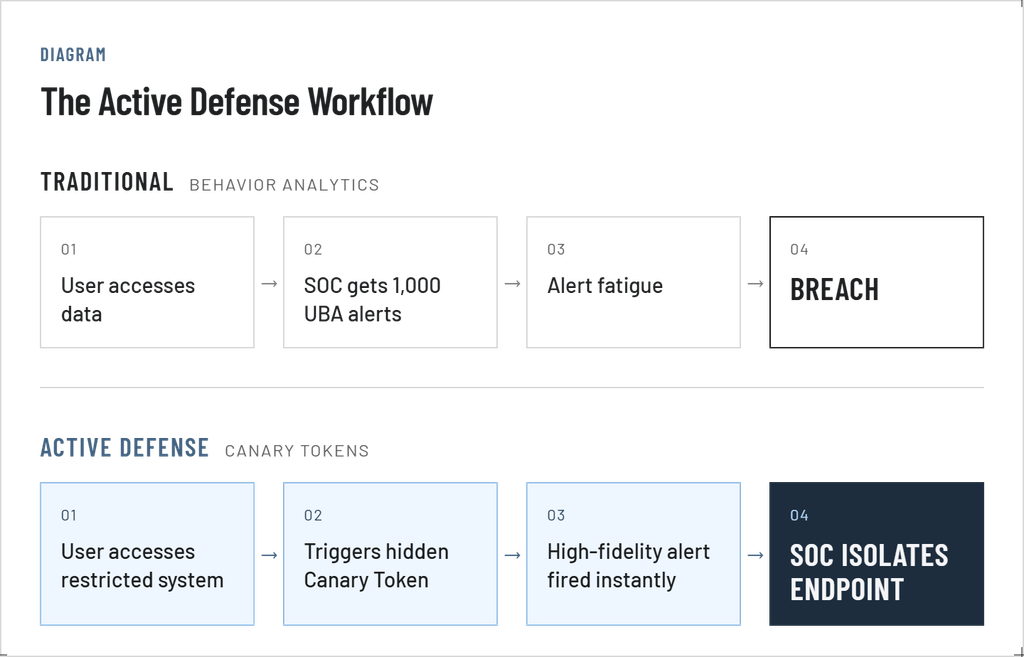
The fundamental flaw in traditional insider threat indicators is reliance on retrospective analysis. User and Entity Behavior Analytics (UEBA) and Data Loss Prevention (DLP) tools are valuable, but they are notoriously noisy. They require security analysts to sift through mountains of false positives to determine whether a data export was malicious or just an employee running a quarterly backup.
To stop data leaks early, security teams must shift from passive observation to active defense from insider threat indicators.
Instead of monitoring every legitimate action an employee takes, proactive security postures involve seeding the environment with deceptive assets. By strategically planting decoy credentials, dummy database records or hidden canary tokens among legitimate files, security teams create digital tripwires.
Deception platforms like Assumed can help. By enabling security teams to effortlessly generate and seed trackable decoy data, such as decoy contacts, honey-credentials, and hidden inbox tokens, Assumed turns passive storage and communications into great insider threat indicators.
Because these deceptive assets serve no legitimate business purpose, they should never be accessed. If an insider like a snooping employee, a compromised vendor or a malicious data thief attempts to copy, open or utilize one of these seeded tokens, the SOC receives an instantaneous, high-fidelity alert. No alert fatigue and no ambiguity: an interaction is definitive proof of unauthorized access. This data-centric deception lets CISOs identify the exact point of compromise and isolate the insider before the crown jewels are exfiltrated.
Frequently Asked Questions
What are the most common types of insider threat indicators? The three most common types are malicious insiders (employees who intentionally steal data for profit or revenge), negligent insiders (staff who accidentally expose data through poor security hygiene) and compromised insiders (legitimate users whose credentials have been hijacked by external attackers).
How do you detect insider threats without invading employee privacy? Privacy-conscious insider threat detection focuses on asset monitoring rather than employee surveillance. Instead of tracking keystrokes or reading personal emails, security teams monitor the data itself, flagging anomalous access patterns, unauthorized privilege escalation or interaction with decoy files like canary tokens.
What is the difference between a malicious insider and a negligent insider? A malicious insider intentionally abuses their access to steal, sabotage or leak corporate data for personal gain, espionage or revenge. A negligent insider causes breaches accidentally by ignoring security policies, falling for phishing scams or misconfiguring systems without any malicious intent.
How do honeypots or canary tokens help in finding insider threat indicators? Canary tokens and honeypots provide high-fidelity, zero-false-positive alerts. Because these deceptive assets have no legitimate business use, any interaction with them, such as opening a seeded file or using a fake credential, instantly flags unauthorized access, allowing teams to stop internal data leaks immediately.
Defending against insider threat indicators requires a delicate balance of trust and verification. By understanding digital, behavioral and financial indicators and implementing modern active defense mechanisms to reduce alert noise, security leaders can protect their most vital data without stifling workplace productivity.
